The magical atmosphere of Tuscany must be discovered day after day in all its nuances: walking in the cities of art, by bike in the parks, by the sea or tasting its many typical products in a naturalistic heritage, cultural and historical unique in the world that has fascinated everyone for centuries.
Arezzo is a city in Tuscany of Etruscan origin, known for its rich artistic and cultural heritage, including the renowned frescoes by Piero della Francesca and works by Giorgio Vasari. The city is also famous for the Giostra del Saracino, a historical reenactment that attracts numerous visitors each year.
Bolgheri is a small medieval village located in the Livorno Maremma, within the municipality of Castagneto Carducci, in the province of Livorno, along the Tyrrhenian coast of Tuscany. It is renowned for its historical, scenic, and food and wine heritage.
Florence needs no introduction.
The capital of Tuscany is one of the most important cities of art in our country and beyond, a true historical and artistic point of reference on a global level.
The beauties of Florence are known to all, and therefore it is not surprising that over 10 million tourists choose to stay in the city every year.
The historic center, enclosed within well-preserved walls, is full of palaces, churches and museums that will feed your eyes with beauty. So have writers and movie stars such as Italo Calvino, Sophia Loren, Dino Risi and Federico Fellini.
The city of Lucca is also traditionally called “City of a Hundred Churches” due to the large number of religious buildings, dating back to different eras. First of all, there is the Cathedral of San Martino, which dates back to the 6th century and is very particular due to the strangeness of its asymmetrical facade, in Roman style.
Pisa is one of the most beloved Italian cities in the world. A place where art, culture, and beauty come together in a magical setting. Its greatest masterpieces are located on the timeless green of the Piazza dei Miracoli: the Cathedral, the Baptistery, the Leaning Tower, and the Camposanto Monumentale.
Every year, Pisa also hosts numerous cultural events, including exhibitions, temporary installations, conferences, and theatrical and musical performances.
Pistoia is a provincial capital and an ancient episcopal see.
It is located at the northwestern edge of the Florentine plain, specifically at the foot of the Apennine Mountains.
It is the northernmost city in Tuscany, set at the base of the Appennine range, and its territory is bordered by the Brana and Ombrone streams.
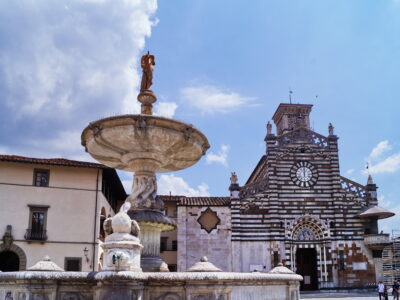
Prato is a Tuscan city rich in history and traditions. Its historic center features important landmarks such as the Prato Cathedral and the Castello dell'Imperatore, as well as modern cultural spaces like the Centro per l'Arte Contemporanea Luigi Pecci. The surrounding area offers hills, small villages, and natural parks, making it an ideal destination for a short trip combining culture, nature, and local food.